
see+

I am happy to announce that together with my friends Andrew Vande Moere and Benjamin Wiederkehr, I am organizing a little informal extension to the see conference on Sunday April 10. We call it see+.
In the morning (i.e. hang-over friendly 11:30), we will have Justin Manor and Wes Grubbs over for an open discussion on information visualization, life, the universe, and all the rest.
And in case you wanted to get your hands dirty in data, in the afternoon (around 14:00), a hands-on workshop on information visualization tools will provide you with a practical overview of how to develop your own interactive data representations.
In case you are still pondering if you should go to the see conference – hesitate no longer – the tickets are becoming scarce! For me, it is always one of the highlights of the infovis year, and I am sure it will be as inspiring as ever.
If you plan to attend see+, let us know on the facebook page or in the comments. Also, all kinds of suggestions for discussion or workshop topics are welcome.
Notabilia — Visualizing Deletion Discussions on Wikipedia
Just in time for Wikipedia’s forthcoming tenth anniversary (congrats!), two researchers – Dario Taraborelli and Giovanni Luca Ciampaglia – approached me for a cooperation on visualizing the discussions around article deletions on Wikipedia. The (intermediate?) results are online at notabilia.net.
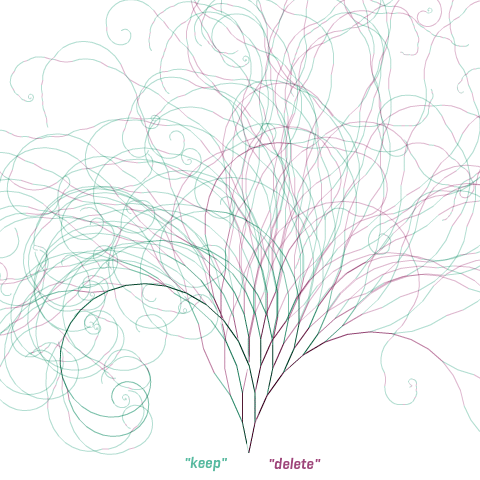
I came up with a tree visualization, where Article for Deletion discussion is represented by a thread starting at the bottom center. Each time a user recommends to keep, merge, or redirect the article a green segment leaning towards the left is added. Each time a user recommends to delete the article a red segment leaning towards the right is added. As the discussion progresses, the length of the segments as well as the angle slowly decay.
In the visualizations, I tried to capture the tension between chaos and order inherent to the discussions, and provide a nice serendipity interface as well.
So much to learn about…
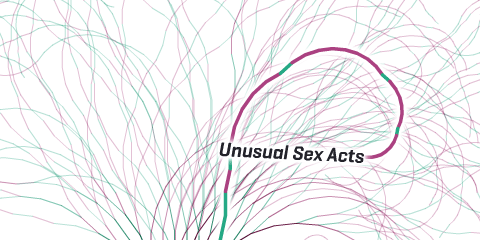 …or…
…or…
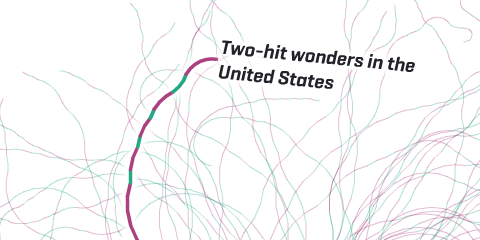 …and…
…and…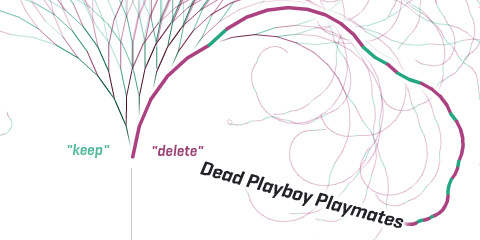
But also some more hard analysis can be found at notabilia.net, looking at the vote distributions, lengths of discussions, etc. Take a look yourself!
Visualizations for the Global Agenda
Just a quick post to announce two visualizations which went live this week, related to the Global Agenda Summit of the World Economic Forum.
Global Agenda Outlook 2011
A half-explanatory, half-exploratory sequence of visualizations, summarizing the results of a survey among Global Agenda Council members about their perceptions of important trends and developments. This “guided” visualization can be quite satisfying, when done right (the New York Times graphics department are clearly masters in that genre), but poses some challenges, both from a technical as well as a conceptual point of view. Overall, I am quite happy with how it turned out and hope I will learn more about this type of mixed exploration/explanation tools.
GAC Issue Browser 2010
This application allows to browse and search for the Global Agenda Councils, based on their interlinkage. (Again, this data is based on a survey, where Council members were asked who their council should cooperate with).
On the start screen, the bubbles representing councils are scaled according to how much interest they received from other Councils. China is huge in this respect.
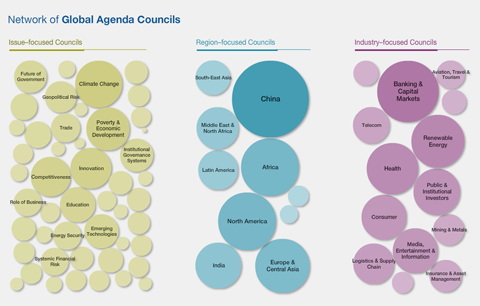
Clicking one of the bubbles will lead you to the detail screen, where you can see the exact interlinkage, and read the survey members’ commentary by hovering over the arrows.

Also noteable: There was a visualizing.org challenge based on the same data, so make sure to check out the results.
Elastic Lists, revisit: open source!

In the past, I have profited immensely from using open source projects, foremost flare, but also many other libraries. I would like to give something back by open sourcing my favorite toy, the Elastic Lists project on github: github.com/MoritzStefaner/Elastic-Lists.
Have fun with it! Please keep in mind I am not a developer by training and these are side projects. Especially excuse the sketchy documentation. So if you start working with the code, and run into issues, feel free to file bug reports or add questions to the FAQ.
Heck, and while I am at it, why not publish revisit as well:
github.com/MoritzStefaner/revisit
see #5

In its five years of existence, the see conference managed to bring quite a few of the most exciting speakers from design, art, architecture and new technologies on stage to talk about their perspective on information visualization.
This year’s conference takes place on April 17, 2010 at the Kulturzentrum Schlachthof Wiesbaden (Germany) and features the following line-up:
- Gideon Obarzanek, the founder of Chunky Move, an Australian dance company known for “genre-defying dance performance”
- Joshua Prince-Ramus, President of REX, a cutting-edge architecture firm
- Nicholas Felton (feltron.com), a New York based information designer, co-founder of daytum.com and probably best known for his personal annual reports
- Hannes Koch from rAndom International, a London-based art and design collective
- Kent Demaine from OOOii, who design future interfaces for Hollywood and, among others, brought us the visionary interface design for Minority Report
- and amystery keynote speaker. (I love mysteries!)
Some tickets are still left, but not terribly many, so better register sooner than later. For those of you who cannot make it, there will be a live video stream of the event, and archived video recordings later. The recorded talks of the past conferences are well worth a visit too, with speakers ranging from Casey Reas over Carsten Nicolai to Stamen’s Eric Rodenbeck, Ben Fry, Zachary Lieberman and many more.
DaVis’10: Design and Aesthetics in Visualization
Everybody complains that art, design and research in information visualization should be talking more to each other.
Here is a unique opportunity: Andrew Vande Moere and I will be hosting a symposium at IV10: DAVis, the 5th International Symposium on Design and Aesthetics in Visualisation.
From the call:
“This symposium aims to bring together researchers and practitioners of design, art and related disciplines. The goal is to share their stories and experiences on how the needs and goals of both users and businesses are met through information visualisation.
It supports the publication of research in two general domains: Design and Aesthetics. Design refers to the development of visualisation as a creative design process. Aesthetics refers to the role of user experience in visualisation, as understood in three distinct components: aesthetic experience, experience of meaning, and emotional experience.
This symposium presents an opportunity to explore these issues and their consequences for the field of information visualization. In particular, we encourage the submission of design critiques; case studies, possibly with accompanying evaluation studies or critical reflections; position papers; or reports on the impact that visualization research or visualization use has had on the work and life of people. In this context, the story of failures or abandoned approaches can be as informative as descriptions of success. The fields of application are open, and can reach from traditional screen-based graphs, over innovative multi-touch interfaces, to dynamic media architecture displays.”
So – designers, coders, artists, visualizers – go forth and write!
Update: make sure to check out the submission requirements and procedure up at the IV main page.
Beware: the deadline is tight: March 1. March 21 But honestly, you would not have started earlier, anyways – right? Feel free to get in touch if you have any questions, and we are really looking forward to your submissions.
Dynamic Taxonomies and Faceted Search:
UI design
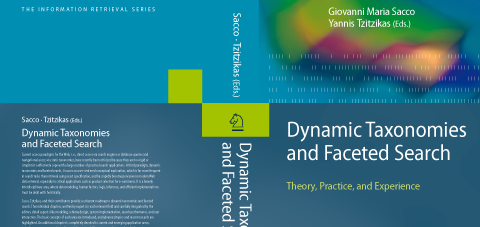
I contributed to the user interface design chapter in the recent Springer book “Dynamic Taxonomies and Faceted Search – Theory, Practice, and Experience” (online version) edited by Giovanni Maria Sacco and Yannis Tzitzikas. Based on a definition of core principles and challenges, the chapter presents a taxonomy of navigation modes observed in existing applications. On that basis, design patterns for enabling these navigation modes in user interfaces as well as extensions and related approaches are discussed. The chapter closes with a section on personalizing faceted search.
The book itself covers a wide range of topics and current research questions related to Dynamic Taxonomies and Faceted Search from an academic point of view.
You can find a pre-print version of the User Interface Design chapter here. Thanks also to my co–authors Sébastian Ferré, Saverio Perugini, Jonathan Koren and Yi Zhang!
Symposium: Living with information
I am excited to announce the following symposium at FH Potsdam:
The symposium »Living with Information: Architecture and Visualization« (October 16 , 2009 at FH Potsdam) will juxtapose experiences and results from the MACE project with thoughts and design approaches from practitioners in the fields of design, architecture and technology. Guided by five central questions, we will explore future trends in information visualization, the relationship of visualization tools and creativity plus issues like information over- and underload.
I am really looking forward to the unique speaker combination we put together:
- Miguel Cardoso from bestiario,
- Paolo Ciuccarelli from Politecnico Milano /density design,
- Georgi Kobilarov from FU Berlin / dbpedia,
- Norbert Palz (CV + info) and
- Andrew Vande Moere from infosthetics.com!
In addition, Prof. Boris Müller and I will provide a rear-mirror view and outlook of our activities related to the MACE project… A wide spectrum, but hopefully all held together by the central issue of the workshop and the five questions we prepared for the speakers.
Hope to see you there – register soon – space is limited!
On a related note, the Potsdam–based W3C office opens on the day before, which should be quite interesting, too.
Talk in Schwäbisch Gmünd
For those from the Stuttgart area: I will give a public (german) talk on Monday, April 20, 6:30pm at HfG Schwäbisch Gmünd on information aesthetics and my work.
Update: lecture slides here. Thanks to Eric Rodenbeck and the other see#4 speakers for some last minute inspirations!
MACE portal update
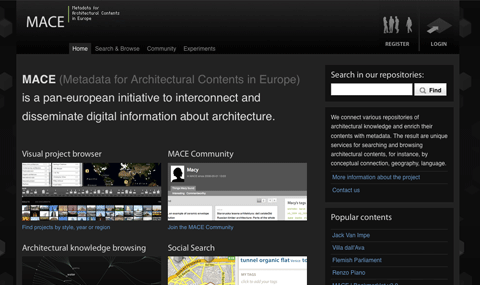
We recently launched a whole new version of the MACE portal. MACE (Metadata for Architectural Contents in Europe) is a pan-european initiative to interconnect and disseminate digital information about architecture. The idea is to connect and enrich various databases containing eLearning material for architectural contents and to connect and make them accessible in novel ways. The project is co-funded by the European commission. If you are more interested in the background of the project, you can also view our info page here. Personally, I am working half of my time on this project here at FH Potsdam.
So, let me give you a little overview of the portal:
→ read more