
Dynamic Taxonomies and Faceted Search:
UI design
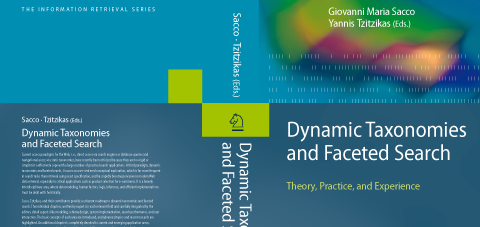
I contributed to the user interface design chapter in the recent Springer book “Dynamic Taxonomies and Faceted Search – Theory, Practice, and Experience” (online version) edited by Giovanni Maria Sacco and Yannis Tzitzikas. Based on a definition of core principles and challenges, the chapter presents a taxonomy of navigation modes observed in existing applications. On that basis, design patterns for enabling these navigation modes in user interfaces as well as extensions and related approaches are discussed. The chapter closes with a section on personalizing faceted search.
The book itself covers a wide range of topics and current research questions related to Dynamic Taxonomies and Faceted Search from an academic point of view.
You can find a pre-print version of the User Interface Design chapter here. Thanks also to my co–authors Sébastian Ferré, Saverio Perugini, Jonathan Koren and Yi Zhang!
Symposium: Living with information
I am excited to announce the following symposium at FH Potsdam:
The symposium »Living with Information: Architecture and Visualization« (October 16 , 2009 at FH Potsdam) will juxtapose experiences and results from the MACE project with thoughts and design approaches from practitioners in the fields of design, architecture and technology. Guided by five central questions, we will explore future trends in information visualization, the relationship of visualization tools and creativity plus issues like information over- and underload.
I am really looking forward to the unique speaker combination we put together:
- Miguel Cardoso from bestiario,
- Paolo Ciuccarelli from Politecnico Milano /density design,
- Georgi Kobilarov from FU Berlin / dbpedia,
- Norbert Palz (CV + info) and
- Andrew Vande Moere from infosthetics.com!
In addition, Prof. Boris Müller and I will provide a rear-mirror view and outlook of our activities related to the MACE project… A wide spectrum, but hopefully all held together by the central issue of the workshop and the five questions we prepared for the speakers.
Hope to see you there – register soon – space is limited!
On a related note, the Potsdam–based W3C office opens on the day before, which should be quite interesting, too.
Neuroscience infoporn
This month’s WIRED UK magazine features a remix of one of the well-formed.eigenfactor visualizations in their infoporn section.
Together with my colleagues in Seattle and Umea, I modified the “change over time” visualization to tell a specific story: The formation of neuroscience as a field of its own right over the last decade. Originally scattered across related disciplines (such as medicine, molecular and cell biology or neurology), the neuroscientific journals start to define a niche of their own, reflected in the dense cluster emerging in 2005.
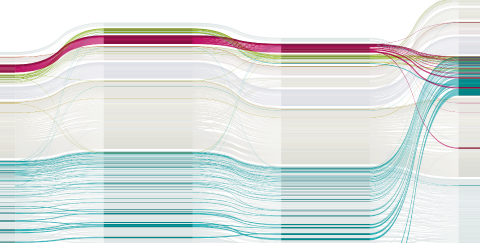
Download a larger version with full explanatory text here: png (1MB) pdf (4MB)
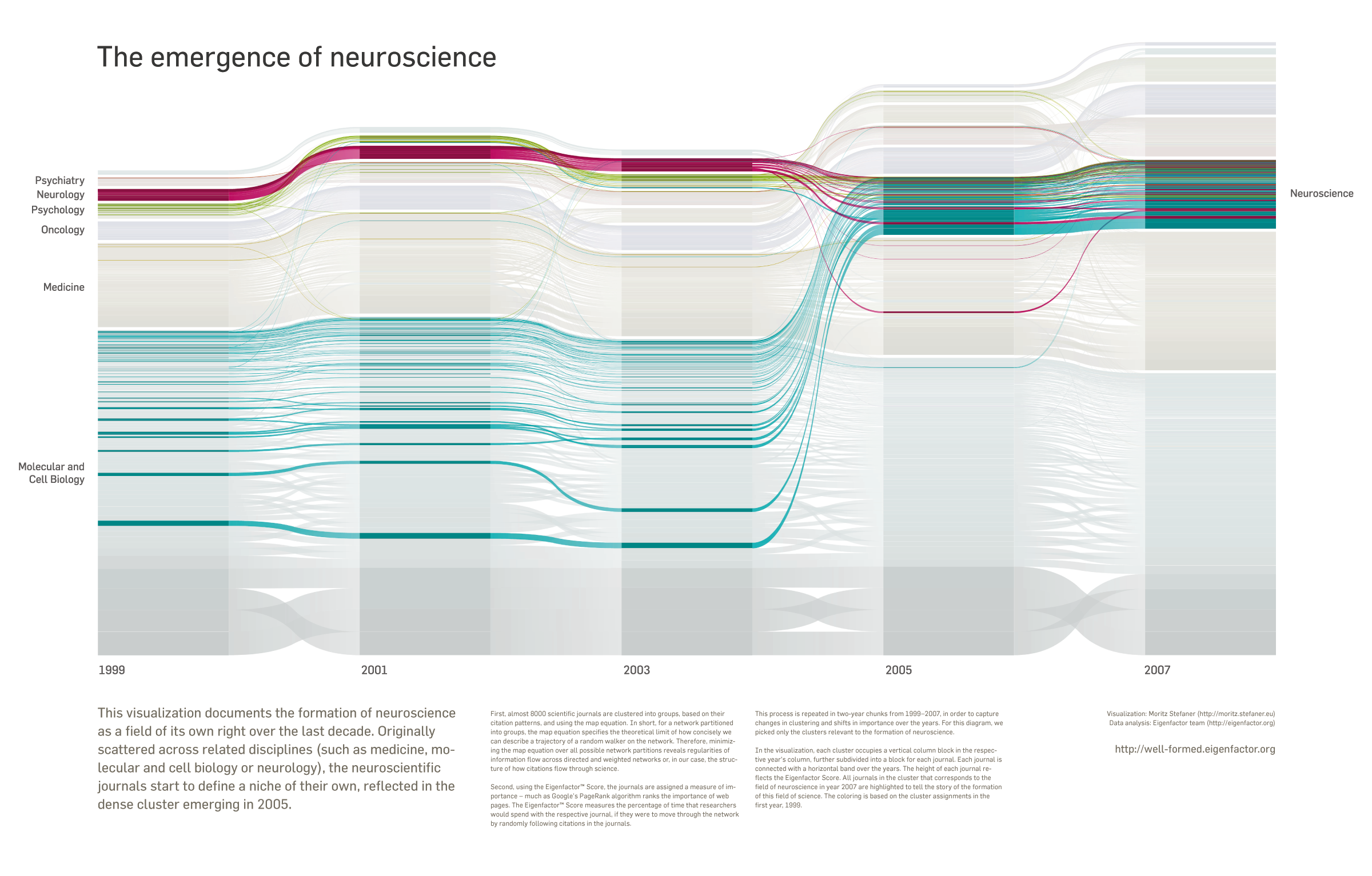
And here is some more in depth info:
→ read more
X by Y
Here’s a new project of mine:

X by Y visualizes all submissions to the prix ars electronica, from the early beginnings in 1987 up to 2009. The goal is to characterize the “ars world” in quantitative terms. A series of diagrams groups and juxtaposes the submissions by years, categories, prizes and countries. The graphics are composed of little dots (each representing a single submission) to provide a visual scale for the statistical statements and thematize the relation of the totality and the individual.
Their placement is computed with a Fibonacci series, imitating the arrangement of sunflower seeds – a very efficient and visually mesmerizing way of packing small elements into a large circle. Color distinguishes the submission categories, and a diamond shape marks submission that have been awarded a prize. The numbers in the center of the diagram elements are constructed by skipping points in the pattern – establishing a tight connection between the number and the individuals, but also demonstrating the duality of the two concepts.
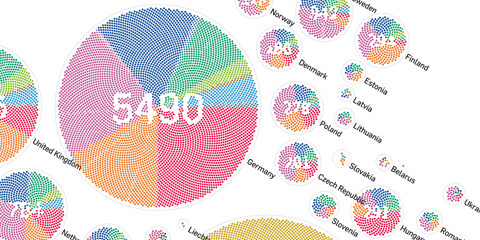
The project is currently at display at the history lounge of ars electronica 09.
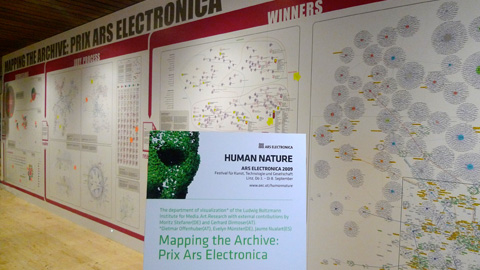
The project was done in cooperation with the Ludwig Boltzmann Institute for media.art.research. Find all diagrams and some more info here: X by Y. Also, don’t miss the other works on the poster over at vis.mediaartresearch.at.