
Exhibit
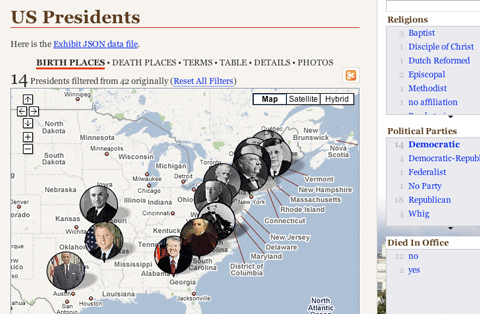
A real wow-project has gone into version 2: Exhibit. It is part of SIMILE, focussing on “Semantic Interoperability of Metadata and Information in unLike Environments”, which provides a whole toolbox of pragmatic semantic web applications.
Exhibit itself presents a “a three-tier web application framework written in Javascript, which you can include like you would include Google Maps.” An exhibit application typically consists of a content presentation area and several widgets for filtering, sorting and grouping the content presentation, following the faceted browsing paradigm also used in my elastic lists. Currently, the available widgets cover plain checkbox lists, maps, and timelines, and a live search.

From my first experiments with the tool, I can say it is really ridiculously easy to create custom views on existing data sets: Data can be imported “from a Google Spreadsheet, Excel spreadsheet, EditGrid spreadsheet, BibTex files or any JSONP data source” without much effort.
Applications are built by loading the exhibit script and then assigning “Exhibit roles” to layers in your java-script: For instance,
<div ex:role="facet" ex:expression=".discipline"
 ex:facetLabel="Discipline" />
will create a filtering widget looking for values of the “discipline” property in your data set and display them as a list to be used for filtering. It couldn’t possibly be easier to build client-side facet browsing applications.
Other nifty are the integrated browser history for filtering steps and the ability to export filtered views as e.g. HTML, but also tab-separated text files, RDF, etc.

Check out the Getting started page to get an impression.
The down side, of course is, that all data has to be loaded on the client before the application can start. So we are rather speaking about hundreds than thousands of data items. Also, I would of course be interested in building custom widgets, however, this looks a wee bit more complicated from first looks into the code. And of course UI-wise, I would have some suggestions as well, but anyways, I find the project quite impressive already as it is!
Kudos to David Huynh and the rest of the team at MIT. More info can also be found in David Huynh’s PhD thesis.
January 13th, 2008 at 7:37 am
[…] Well-formed Data’s post on Exhibit led me to explore what was available from MIT’s Semantic Interoperability of Metadata and Information in unLike Environments (SIMILE) project. I took a little time to examine some of the SIMILE project tools with an eye to how they could impact interaction with archival records and metadata, as well as how they might support the work of archivists. All the tools appear to be available via an open source BSD license. […]
January 15th, 2008 at 10:15 am
More discussion and praise can be found at:
http://blog.jonudell.net/2007/12/06/simile-semantic-web-mashups-for-the-rest-of-us/
March 31st, 2008 at 6:04 pm
[…] found on Well-formed data […]