
Neuroscience infoporn
This month’s WIRED UK magazine features a remix of one of the well-formed.eigenfactor visualizations in their infoporn section.
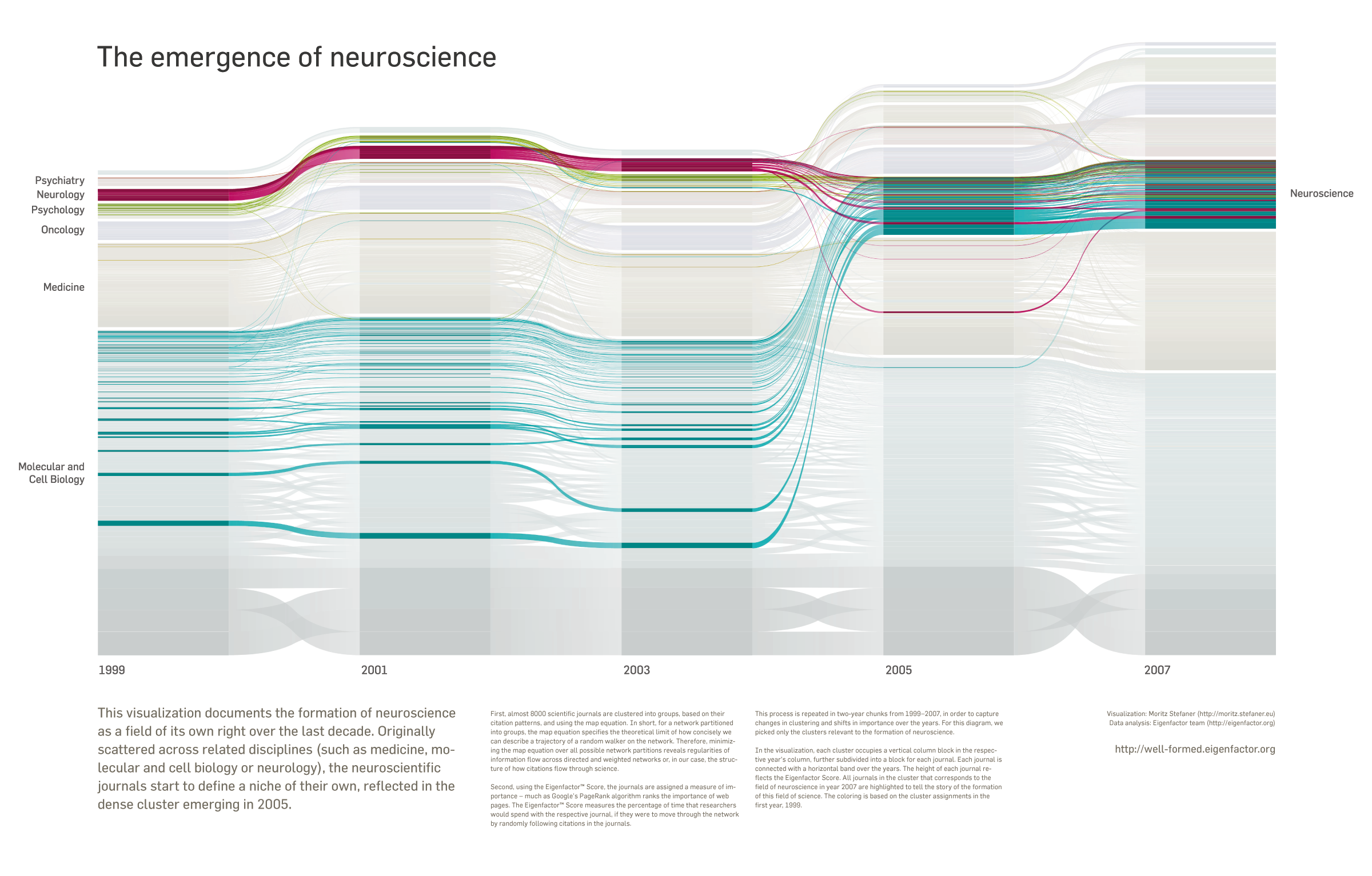
Together with my colleagues in Seattle and Umea, I modified the “change over time” visualization to tell a specific story: The formation of neuroscience as a field of its own right over the last decade. Originally scattered across related disciplines (such as medicine, molecular and cell biology or neurology), the neuroscientific journals start to define a niche of their own, reflected in the dense cluster emerging in 2005.
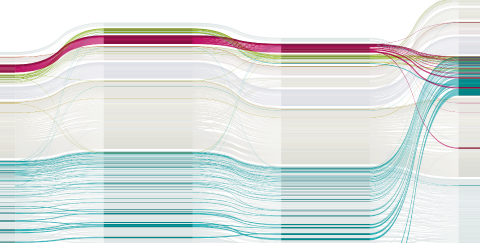
Download a larger version with full explanatory text here: png (1MB) pdf (4MB)
And here is some more in depth info:
First, almost 8000 scientific journals are clustered into groups, based on their citation patterns, and using the map equation (demo, paper). In short, for a network partitioned into groups, the map equation specifies the theoretical limit of how concisely we can describe a trajectory of a random walker on the network. Therefore, minimizing the map equation over all possible network partitions reveals regularities of information flow across directed and weighted networks or, in our case, the structure of how citations flow through science.
Second, using the Eigenfactor™ Score, the journals are assigned a measure of importance – much as Google’s PageRank algorithm ranks the importance of web pages. The Eigenfactor™ Score measures the percentage of time that researchers would spend with the respective journal, if they were to move through the network by randomly following citations in the journals.
This process is repeated in two-year chunks from 1999–2007, in order to capture changes in clustering and shifts in importance over the years. For this diagram, we picked only the clusters relevant to the formation of neuroscience.
In the visualization, each cluster occupies a vertical column block in the respective year’s column, further subdivided into a block for each journal. Each journal is connected with a horizontal band over the years. The height of each journal reflects the Eigenfactor Score. All journals in the cluster that corresponds to the field of neuroscience in year 2007 are highlighted to tell the story of the formation of this field of science. The coloring is based on the cluster assignments in the first year, 1999.
We use a subset of the citation data from Thomson Reuters’ Journal Citation Reports 1999–2007. The complete data aggregate, at the journal level, approximately 35,000,000 citations from almost 8000 journals over the past decade, but here we only display journals relevant to the formation of neuroscience.
September 12th, 2009 at 12:54 pm
@Moritz,
As someone who is very interested in Neuroscience, I found this extremely interesting. I’ve placed links to this post and chart on the Forum of the ALS Therapy Delevopment Institute http://www.als.net/forum/Default.aspx?g=posts&t=47613
April 6th, 2010 at 4:49 am
[…] they become more interesting when they reveal patterns in the data. The convergence of separate science disciplines upon neuroscience research around 2005, created by the Well-formed.eigenfactor project, is one such striking example. […]
April 7th, 2010 at 1:04 am
[…] they become more interesting when they reveal patterns in the data. The convergence of separate science disciplines upon neuroscience research around 2005, created by the Well-formed.eigenfactor project, is one such striking example. […]
April 14th, 2010 at 11:31 am
[…] they become more interesting when they reveal patterns in the data. The convergence of separate science disciplines upon neuroscience research around 2005, created by the Well-formed.eigenfactor project, is one such striking example. […]
October 6th, 2010 at 6:43 am
[…] they become more interesting when they reveal patterns in the data. The convergence of separate science disciplines upon neuroscience research around 2005, created by the Well-formed.eigenfactor project, is one such striking example. […]
March 29th, 2011 at 7:57 pm
[…] visualization is based on the work by Moritz Stefaner to show the formation of neuroscience as a […]
June 21st, 2013 at 8:01 pm
ペアからそれを使用してブランドコストだけ何か$200の間とさらに$400。彼らもトラクションイベント、コンベンション、会議を含め、毎年と香りボトルオークション。中シャネルに得て手首チェックアウトやや遅れて市場、それを持っていますできたかなり得る単一忠実な顧客角度。–シャネル チェーンバッグ
November 3rd, 2013 at 1:11 pm
[…] they become more interesting when they reveal patterns in the data. The convergence of separate science disciplines upon neuroscience research around 2005, created by the Well-formed.eigenfactor project, is one such striking example. […]