
Parallax
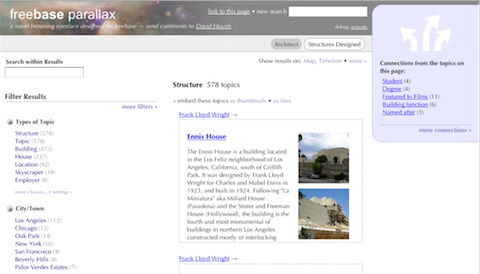
David Huynh has recently joined the freebase team, after having worked on Exhibit and other SIMILE tools at MIT. His new project Parallax is obviously based on Exhibit (which followed mostly a faceted filtering paradigm) but demonstrates a really interesting “sidewards browsing technique” for navigating related sets of different types of entities.
As an example, you could start with a set of architects, then filter down to all modern architects, plot them on a map, a timeline etc. – quite nice already, but traditional facet browsing in principle. The catch however, is that you can explore related collections, like the buildings they designed,
their birth places etc. in the same manner. Very interesting principle and nicely executed, yet a bit hard to explain.
In this screencast, David explains it himself:
Freebase Parallax: A new way to browse and explore data from David Huynh on Vimeo.
As a side remark: academically, I think the Humboldt paper by Georgi Kobilarov first presented this principle (but they also refer to an earlier prototype of David’s work). Unfortunately it was introduced under the name of pivot browsing, which is sort of reserved already for the quite related, but not identical principle introduced in dogear.
Any ideas for a good name? Sidewards browsing? Entity shift? Or just stick with parallax?
August 14th, 2008 at 11:17 pm
Set browsing? Venn browsing? Union browsing?
Since you are finding sets related to sets, using some set terminology would be apt.
MSN
August 14th, 2008 at 11:35 pm
Commercially, as acknowledged by the Humboldt paper, we at Siderean were the first to provide an implementation of pivot browsing, which is the phrase our customers have for better or worse adopted as well.
August 15th, 2008 at 1:51 am
I’m all for entity shift! Or maybe entity pivoting? ;-)
Parallax is a fascinating demonstration for sure; however, a powerful exploration (and query formulation) tool like that makes it all the more obvious how Freebase (still) has a Herculean task in front of them when it comes to data quality & coverage.
Maybe sponsoring DBpedia wouldn’t be a bad idea …
August 15th, 2008 at 9:17 am
@Bradley: Thanks for note, forgot to mention that! I know the term pivot browsing for the quite ubiquituous “find a resource, click one of its tags to find more of its kind” navigation principle. The term pivot really makes sense in this context.
But when you go from modern architects to the buildings they designed (two sets) isn’t this something different in principle? And what is the pivot?
Now I got it: Massive-multi-parallel-pivoting :)
August 16th, 2008 at 6:06 am
[…] Well-formed data posted about a new Freebase project named Parallax. This new search interface takes faceted browsing another step – in this case making it easy to jump sideways from one dataset to another related dataset. Parallax still includes filters on the left side – but the twist comes from the opportunity to select what are called ‘Connections’ from the list in the upper right hand corner of the search results page. […]
August 17th, 2008 at 10:01 am
Hi Moritz,
Thanks for the link to Georgi’s paper! I talked with him at length when he was developing Humboldt, but didn’t realize he has published it to a WWW workshop.
I’m glad you asked what to name the principle… You’re the first one to think of that among all the blog posts I’ve seen. I’ve toyed with the term “link sliding” over the past few years. What I want to convey in that term is the difference from “link hopping”. Link hopping is jumping from one web resource to another over one web link, whereas link sliding is going along several links simultaneously. It’s not a terribly descriptive or even cool-sounding term, but I haven’t been able to come up with anything better. Stefano Mazzocchi mentioned that term here:
http://www.betaversion.org/~stefano/linotype/news/153/
Now I purposely don’t use “pivot” because at least in my mind, “pivot” implies a limited number of dimensions as well as a limited data set that you figuratively hold in your hands and turn to different sides to get different perspectives. With “link sliding”, I’d like to convey the image of an infinite data set, and you’re simply browsing through it with more efficiency by going through several links at the same time. There is also a subtle difference between querying and browsing in the mindset.
The reason for conveying the image of more efficient browsing through an infinite data set is to get this new interaction paradigm more congruent with conventional web browsing, so that it might be more easily grafted onto existing web browsers.
I think it’d be awesome if we can figure out a better term than “link sliding”, or at least talk ourselves into believing that it’s not so awful :-)
David
August 17th, 2008 at 10:05 pm
@David: Thanks for the reply! I agree that pivoting has different connotations and should really be kept for “flipping around a fixed/shared point” which is not what the technique is about, really. Sliding or panning indeed makes sense, as opposed, e.g., to zooming or flipping.
So, how about “related set panning”? “related set browsing”? “slide by relation”? “pan by relation”?
August 19th, 2008 at 3:04 am
I like “panning” as a visual metaphor, but I’m not sure if everyone would get it. I suppose we might have to settle for the more mundane phrases like “related set browsing”… But that’s not as cool as “faceted browsing”.
August 19th, 2008 at 4:34 pm
[…] via Well-formed Data […]
August 20th, 2008 at 1:32 am
Hi there,
very interesting discussion about the term “pivoting” :)
And indeed, the metaphor I started with, was zooming and panning. But I never got the distiction between those two for the pivot operation, because it does at the same time increase the level of detail for a given set of things, as well as browsing to a different set of things with the same level of details.
Anyway, I think there is a great chance to do some collaboration here, especially since you guys are just around the corner…
And @Christian: yes, sponsoring DBpedia *is* a good idea! :)
Cheers,
Georgi
January 10th, 2009 at 7:00 pm
[…] http://microformats.org/ – bookmarked by 4 members originally found by browenhorst on 2008-12-13 Well-formed data » Parallax /archives/153/parallax – bookmarked by 5 members originally found by […]
March 29th, 2009 at 10:43 pm
[…] in parallax and humboldt, this navigation mode follows the same metadata link on the whole result set to […]